
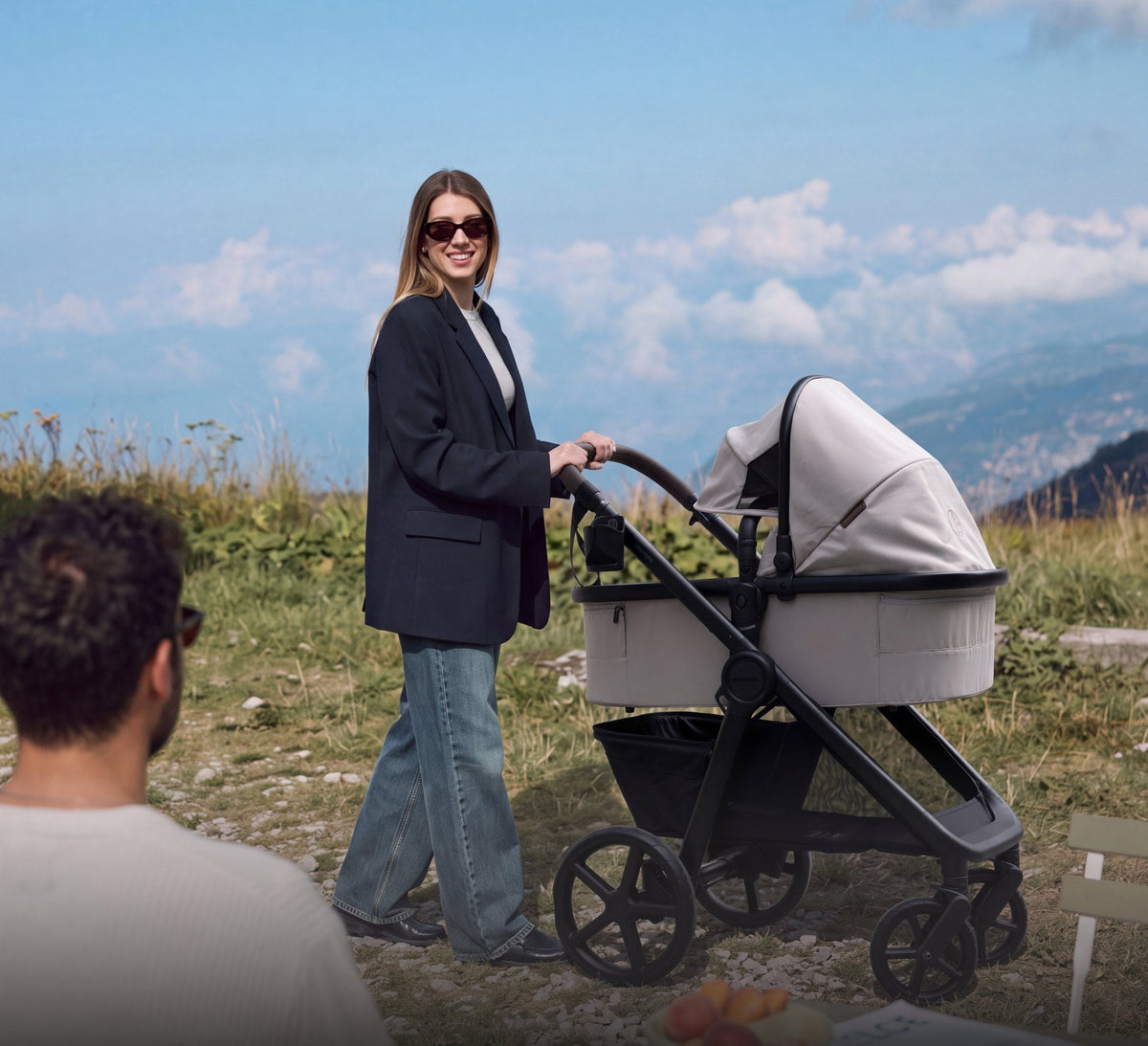
Maya and Dan stood in front of the stroller wall at their local baby store for forty minutes. She was eight months pregnant, he was holding a printout of their registry, and neither of them could answer the question the saleswoman kept asking: "Do you want a bassinet stroller or a regular one?"
They ended up adding a bassinet attachment to the registry, mostly out of guilt. Three weeks after their daughter was born, they realized it was the single most-used item on the entire list.
If you're preparing for a newborn, the bassinet stroller vs regular stroller decision probably feels like one more thing to agonize over. Here's the short answer: newborns need a flat, firm surface to ride on, and most regular strollers don't provide one. But that doesn't mean you have to buy two strollers. In this guide, you'll learn why the flat-surface rule matters and how long a bassinet actually lasts. We'll also cover when a regular stroller is genuinely fine, and how a convertible stroller with a bassinet mode can give you both without doubling your budget.
Key Takeaways
- Newborns should ride fully flat, not semi-reclined, because flat positioning supports spinal development, open airways, and healthy head shape.
- The AAP advises limiting time in car seats and other semi-reclined devices to about 2 hours per day, which is easy to exceed on a busy day out.
- Most babies outgrow a stroller bassinet between 3 and 6 months; rolling over is the hard deadline, and 15 to 20 pounds is the typical weight cap.
- A regular stroller works from birth only if its seat reclines to a true flat position; otherwise, wait until your baby can sit with support (around 6 months).
- A convertible stroller with a bassinet mode, like the Mompush Ultimate 2, gives you both options in one purchase instead of forcing you to choose.
What Is a Bassinet Stroller? (And What Counts as "Regular")
A bassinet stroller is a stroller that carries your baby in a bassinet: a flat, enclosed basket with a firm mattress and raised sides. Your newborn lies completely horizontal, the way they would in a crib, just with wheels. Some bassinets are permanent parts of the frame. More commonly these days, a bassinet mode is built into a convertible stroller, where the seat folds flat or a bassinet module clicks onto the same chassis.
A regular stroller, by contrast, is what most people picture when they hear the word "stroller": a seat with a backrest, a harness, and a footwell. The seat reclines, but even at its flattest setting it rarely reaches a true 180 degrees. It's designed for babies who can sit and, eventually, toddlers who want to see the world.
There's a confusing middle category too: strollers advertised as "newborn suitable" because the seat reclines to a near-flat angle. That's the gray zone where most registry confusion happens, and it's exactly where the safety question lives.
The Core Difference: Fully Flat vs. Reclined — Why It Matters for Newborns
A newborn's body is not a small version of a toddler's body. Until roughly 3 to 4 months, babies have no head or trunk control, and their spines are a C-shaped curve rather than the adult S-curve. Their airways are soft and easily compressed, too. How you position that body for hours every day matters more than most parents realize.
When a baby lies fully flat, the spine rests in its natural curve, the airway stays open because nothing flexes the chin toward the chest, and pressure distributes evenly across the skull. When a baby sits semi-reclined at 30 to 45 degrees, gravity slides the body down the seat, the chin tends to drop toward the chest, and the back of the head takes the load for the entire ride.
Pediatric guidance is consistent on this. The American Academy of Pediatrics recommends that infants sleep on firm, flat surfaces, and its guidance on travel is clear that car seats and similar devices are for travel, not for extended or unsupervised rest. The CPSC has likewise warned for years that babies should not be left to sleep in sitting or inclined products.
Spine, Airway, and Head-Shape Development
Three specific concerns drive the flat-surface recommendation:
- Spinal development. A curved, unfused spine needs to lie flat to grow without distortion. Hours of crumpled, chin-to-chest positioning is exactly what pediatricians want new parents to avoid.
- Airway safety. Newborns can't lift or turn their heads to reposition. In a semi-reclined seat, a slumped posture can narrow the airway, and a sleeping baby may not wake up to fix it. Fully flat removes the risk entirely.
- Plagiocephaly (flat head syndrome). In 2026, pediatric PTs still see it regularly: babies who spend long stretches in car seats, swings, and reclined strollers develop flat spots on the back of the skull. A bassinet alternates pressure across the whole head instead of concentrating it at one point, and the "tummy time" a bassinet naturally pairs with (carrying, floor play) helps too.
- Vestibular input. Lying flat lets a baby's head turn freely from side to side, which feeds the vestibular system that underlies balance and coordination. A strapped-in reclined seat limits that movement.
None of this means a semi-reclined seat will harm your baby in a fifteen-minute trip. The issue is cumulative hours, which brings us to the rule most families break without knowing it exists.
The AAP 2-Hour Car Seat Rule
The AAP advises that babies shouldn't spend more than about 2 hours per day in a car seat, bouncer, swing, or other semi-reclined device, awake or asleep. The rule exists because car seats are engineered to protect a baby in a crash, not to be a comfortable all-day seat.
Here's the math that trips people up. A drive to grandma's: 50 minutes in the car seat. A store run with the car seat snapped into a stroller frame: another 45. Errands on Saturday afternoon: another 40. You've blown past the 2-hour guideline before lunch, and you're not doing anything unusual.
The fix isn't to stay home. It's to move the non-driving hours out of the car seat and onto a flat surface. That's precisely what a stroller with a bassinet does: the car seat stays in the car where it belongs, and the baby rides flat the rest of the way. It's the difference between the car seat being a 20-minute tool and a 3-hour cradle.
Bassinet Stroller vs. Regular Stroller: Side-by-Side Comparison
| Feature | Bassinet Stroller (or Bassinet Mode) | Regular Stroller |
|---|---|---|
| Riding position | Fully flat (180°), firm mattress | Reclined seat, rarely a true 180° |
| Newborn suitability | From day one | Only if the seat flattens completely; otherwise from ~6 months |
| Age window | About 0 to 6 months (until rolling) | About 6 months to 3+ years |
| In-ride sleep | Safe for supervised naps | Restless; head flops in reclined seats |
| Weight cap for newborn mode | Typically 15 to 20 lb | N/A for the seat itself (up to 50 lb in toddler mode) |
| Airway and head-shape impact | Best possible positioning | Acceptable only once head control is established |
| Car-seat compatibility | Often pairs with an infant car seat adapter | Varies by model |
| Typical cost | Higher as a dedicated pram; included or modular in convertibles | Lower to mid-range |
| Best for | Daily walks, errands, newborns under 6 months | Older babies and toddlers, travel, everyday use |
Read the table as a timeline rather than a verdict. The bassinet wins the first six months. The regular seat wins everything after. The only question that remains is whether you buy two products or one that converts.
How Long Can Your Baby Use a Bassinet Stroller?
Short answer: somewhere between 3 and 6 months, and your baby will tell you exactly when.
The hard deadline is rolling over. Once your baby can roll, a flat bassinet is no longer a safe place to ride, because a rolling baby can end up face-down where the raised sides and mattress limit airflow. That milestone typically lands between 3 and 4 months, though some babies get there earlier and some later. If your stroller's bassinet has a weight limit (most list 15 to 20 pounds), stop using it when your baby hits either the milestone or the weight cap, whichever comes first.
Priya, a mom in Austin, got this reminder the vivid way. Her son was 4 months old, and one Saturday afternoon he rolled from back to tummy in the stroller bassinet mid-walk, silently, in about two seconds. She caught it because she was right there looking at him. "He used the bassinet for exactly one more block," she told her moms' group. "Then we switched the seat on and never looked back."
That's the healthy ending to the bassinet story: your baby outgrows it because they're developing on schedule. The transition itself is simple. Once your baby has strong head control and can sit with support, usually around 5 to 6 months, the regular stroller seat at a semi-reclined angle becomes both safe and, honestly, more fun for them. A baby who can watch the world go by is a calmer stroller passenger than one stuck staring at a canopy.
If you're weighing whether the 4-to-6 months of use justifies the purchase, it may help to see how it compares with other new-parent gear decisions, like the travel stroller vs full-size stroller question, where the same "how long will we actually use this?" logic applies.
When a Regular Stroller Is Enough
We like bassinets, but not every family needs one, and pretending otherwise would be doing you a disservice. Here are the honest scenarios where a regular stroller serves you fine:
- Your newborn is already 4 or 5 months old. With good head control and a seat that reclines close to flat, a convertible regular stroller can bridge the remaining weeks.
- You drive almost everywhere and walks are rare. If your stroller comes out twice a month for a 20-minute errand, a lightweight stroller like the Mompush Nexis with a deep recline may be all you'll ever need once baby has head control.
- Your car seat does the infant months. Some families pair an infant car seat with a frame stroller for the first months and accept the 2-hour rule discipline that requires. It can work if your outings stay short and you genuinely move the baby to flat surfaces at home between trips. Most people underestimate how hard that discipline is, but for some schedules it's realistic.
- Budget is the binding constraint. A good full-size stroller used from 6 months onward is a perfectly sound plan. It's not the ideal newborn setup, but "ideal" isn't the only standard that matters.
The one thing that is not fine: propping a newborn into a regular stroller seat at 45 degrees because the product page said "suitable from birth." Newborns can't stabilize their own heads. A near-flat claim and a truly flat surface are not the same thing, and your baby is the one who notices the difference.
The Third Option: A Stroller That's Both
Here's the part the stroller wall at the baby store doesn't make obvious: for most families, this isn't actually an either-or decision. The bassinet mode you need for the first six months can be a feature of the stroller you'll use for the next three years, rather than a separate pram you sell on Facebook Marketplace when your baby turns six months old.
That's the design logic behind the Mompush Ultimate 2, a full-size baby stroller whose seat converts into a fully flat bassinet. Same frame, same wheels, same fold. Months 0 through 6, your newborn rides flat in bassinet mode. Month 6 onward, it becomes a regular stroller seat with a multi-position recline, adjustable footrest, and room to grow. The Ultimate 3 takes the same idea further with premium suspension for families who log serious sidewalk miles.
Ellie and Marcus live in a second-floor walk-up in Brooklyn, the exact situation where one stroller has to do everything. No garage, no storage closet, one hallway already crowded with a swing and a bouncer. A dedicated bassinet pram plus a full-size stroller would have meant two frames wedged behind the stroller and an argument waiting to happen on every stair landing. One convertible stroller with a bassinet mode meant one fold, one carry, one footprint in the corner. They used the bassinet mode daily for five months, and the stroller is still in service two years later with their second baby.
Compare the money too. A standalone pram plus a quality regular stroller typically lands well above a single convertible with bassinet mode included. Fewer pieces, less storage, no six-month gap where your first purchase is gathering dust. One planning note: if a second baby is already on your horizon, the conversion logic changes, and our guide to a double stroller for newborn and toddler walks through that version of the decision.
How to Choose: 5 Questions to Ask Before You Buy
Work through these five questions and the right answer usually picks itself.
- How old is your baby right now? Under 3 months: flat surface is non-negotiable. Between 3 and 6 months with a roller: bassinet mode is already behind you, buy for the future. Not born yet: a convertible covers both windows.
- How do you actually spend your days? Urban walkers log daily stroller hours and get the most out of bassinet mode. Car-first suburban families should think harder about how many of those car-seat hours are avoidable. Frequent flyers will want to factor in how a bassinet mode affects fold size.
- Where will the stroller live? Measure your hallway, trunk, and stairwell honestly. One convertible frame beats two pieces of gear in any space-constrained home, and it beats them again in the car trunk.
- What's your total budget, not your stroller budget? Price the full journey: infant months plus toddler years plus any add-ons. A $200 stroller that needs a $150 bassinet attachment and a $60 car seat adapter is a $410 decision. The Ultimate 2 at $329.99 with bassinet mode built in is the kind of math that ends registry arguments.
- Can you try before you commit? Look for trial windows and return policies you can actually use. Mompush ships free, offers a 100-day risk-free trial, and backs its strollers with a 4-year extended warranty. That matters more in month 4 than any spec sheet does in month 0.
If you answered "under 3 months" and "daily walks" to the first two questions, stop deliberating. You need bassinet mode, and the cheapest safe path to it is the convertible you'll keep using anyway.
FAQ
Do I really need a bassinet stroller for a newborn?
If your baby will spend more than short, occasional stretches in the stroller before 6 months, yes. Newborns need a fully flat surface for healthy spinal development, open airways, and even pressure on the skull. A convertible stroller with bassinet mode is usually the most economical way to get it, since you keep using the same stroller long after the bassinet months end.
How long can a baby use a bassinet stroller?
Most babies use a stroller bassinet from birth until 3 to 6 months of age. Two limits apply: the manufacturer's weight cap, typically 15 to 20 pounds, and the rolling milestone. Whichever comes first ends bassinet use. A baby who rolls at 3.5 months needs the transition then, even if the weight limit allows more.
When should I transition from bassinet to stroller seat?
Transition when your baby rolls over, which usually happens between 3 and 4 months; rolling is the hard safety deadline because a face-down position in a bassinet restricts airflow. If rolling hasn't happened by 5 to 6 months, or your baby exceeds the weight limit, transition then. Strong head control makes the switch comfortable.
Can a baby sleep overnight in a stroller bassinet?
No. Stroller bassinets are approved for supervised naps on the go, not for unsupervised or overnight sleep. Pediatric safe-sleep guidance calls for a firm, flat surface meeting crib safety standards in the same room as parents. Move your baby to a crib or bassinet approved for sleep once you're home.
Is a bassinet stroller worth it if I mostly drive?
Often, yes. Car seats shouldn't be used beyond about 2 hours per day, and drives plus errands add up fast. A bassinet stroller lets you take the baby out of the car seat for the walking portions, keeping total semi-reclined time within pediatric guidance. If your walks are genuinely rare, a deep-recline seat used after 6 months can suffice.
Can a newborn ride in a regular stroller?
Only if the seat reclines to a truly flat position and stays flat, not near-flat. A semi-reclined seat allows a newborn's head to slump forward and compress the airway. If a regular stroller doesn't flatten fully, wait until around 6 months, when head control is established, or choose a model with a bassinet mode.
The Bottom Line: Flat Now, Flexible Later
The bassinet stroller vs regular stroller debate looks like a product choice, but it's really a timeline question. Your newborn needs a flat, firm surface for roughly the first six months. After that, they need a comfortable, secure stroller seat for years of errands, park loops, and vacations. Regular strollers only do the second job well. Dedicated bassinet prams only do the first.
The families who win this decision are the ones who refuse the either-or framing entirely. A stroller that converts between bassinet mode and a regular seat means you buy once, ride flat from day one, and skip the six-month resale ritual. That's why we built the Ultimate 2 around bassinet mode, and why it comes with a 100-day risk-free trial: if your baby proves us wrong about what they need, you send it back and pay nothing.