
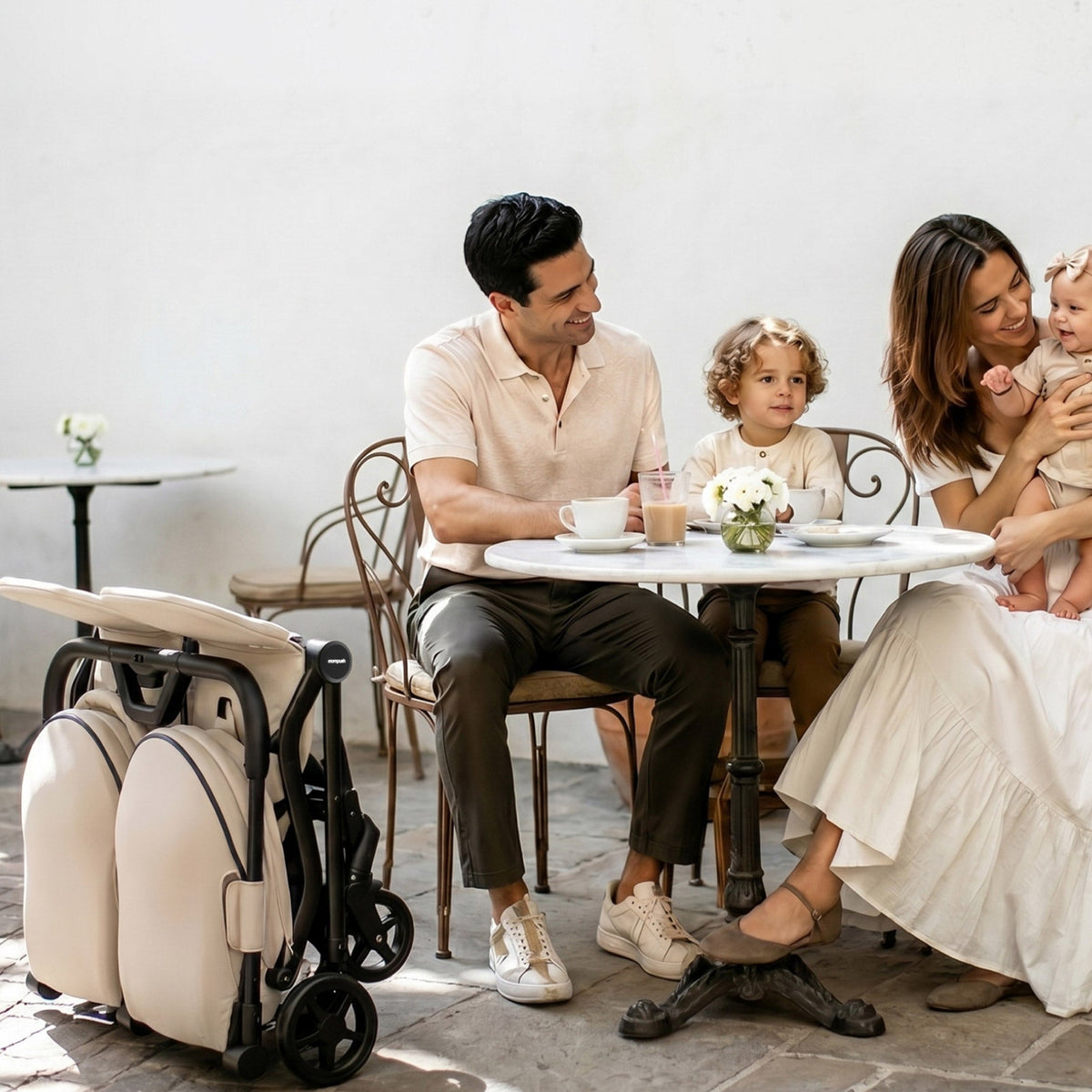
The best travel stroller for flying is light enough to carry with a child on your hip, folds compactly — most U.S. airline sizers run about 22×14×9 inches, though every airline sets its own stroller rules — and opens and closes quickly with one hand. If you're flying with a newborn, add whatever configuration the manufacturer approves for from-birth use: an approved bassinet or nest setup, a newborn-rated seat, or infant car seat compatibility. Recline angle alone does not establish newborn suitability.
That single paragraph eliminates about half the strollers on the market. The rest of this guide shows you exactly how to apply it: what the airlines actually allow, which features matter at 30,000 feet, and which stroller to pick based on your child's age and your flight frequency.
Key Takeaways
- Aim for a stroller under 15 lb with a slim fold near the standard U.S. carry-on limit of about 22×14×9 inches; the Mompush Nexis hits 11.5 lb, but its folded size (18.1×7.9×19.1 in) exceeds the 14-inch side of many U.S. sizers — it fits IATA's ~22×18×10 guideline, so cabin carry is not guaranteed on every U.S. airline.
- Most major U.S. airlines let you gate-check one stroller per child for free, but the terms vary by carrier; cabin carry gives you wheels until the aircraft door, while any checked stroller is exposed to handling.
- No stroller is guaranteed an overhead bin spot; regional jets have smaller bins, so a compact fold improves your odds.
- For newborns, what matters is a manufacturer-approved from-birth configuration — an approved bassinet or nest setup, newborn-rated seat, or infant car seat compatibility — not the recline angle alone.
- Must-have flying features: one-hand fold, carry strap, travel bag, UPF canopy, and a deep recline for naps in the terminal (the stroller itself is folded and stowed on board).
What Makes a Good Travel Stroller?
Four things, in order of importance for air travel:
- Weight. Under 15 pounds is the sweet spot. You will carry this stroller: up jet bridge ramps, down terminal corridors, through security while holding a baby. Every pound counts twice when your other arm is occupied.
- Fold. Look for a slim, self-standing or one-hand fold that you can execute with a child on your hip. A fold that requires two hands and a flat surface is a fold that fails at the aircraft door.
- Wheels. Small wheels are fine on airport terrazzo. Just make sure the front wheels swivel properly, because terminals are longer than you think.
- Recline. A deep recline keeps an eligible child comfortable through terminal waits, delays, and layovers — within the model's age and configuration requirements. On board, the stroller is folded and stowed; it is not an in-flight child seat or sleep space.
If you're still deciding whether you need a travel stroller at all, our travel stroller vs full size stroller guide covers that decision first. This article assumes you've made the call and want the right model.
Lightweight vs. Compact: Which Matters More When Flying?
Short answer: compactness matters more.
Cabin acceptance depends on the operating airline's stroller policy, the aircraft, the space available, and the stroller's folded dimensions — and some airlines also set stroller weight limits for cabin or gate-check acceptance, so check both numbers. A 17-pound stroller with a slim fold can often ride in the cabin or gate-check gracefully, while a lighter stroller with a wide, awkward fold gets wedged into the sizer and turned away. When you're evaluating any lightweight travel strollers, check the folded dimensions before the weight number.
That said, the two traits usually travel together in good designs, and weight wins the tiebreaker. The moment you miss a connection, an 11.5-pound stroller you can sling over your shoulder beats a 17-pound one you must roll through a crowded concourse.
Can You Bring a Stroller on an Airplane?
Yes, and the rules are more generous than most new parents expect:
- In the cabin: If your folded stroller fits the airline's carry-on size limits, you can usually bring it aboard and stow it in an overhead bin or closet. Flight attendants sometimes have closet space for small folds; it never hurts to ask at the door.
- Gate-check: Most major U.S. airlines gate-check one stroller per child at no charge. You push it to the jet bridge and fold it at the aircraft door — but where you hand it over, where it's returned, and any weight or size conditions vary by carrier, so check your airline's current stroller policy before you fly.
- Counter-check: Checked at the ticket counter and carried in the hold. As with any checked item, handling exposes the stroller to wear; a travel bag reduces the exposure. Check your airline's rules for checked-stroller conditions.
Two practical notes: bring a gate-check bag to keep grease off the seat fabric, and check your specific airline's dimensions before departure, because carriers publish slightly different limits and regional aircraft vary most.
Illustrative scenario, not a reported observation: picture a packed boarding line. A father fights a 26-pound stroller fold at the jet bridge with a toddler balanced on his hip; two gate agents and four minutes later, the stroller heads down the ramp. Behind him, a parent presses a button, hears the frame click into itself, slings it over a shoulder, and boards. Same flight, same rules. The point isn't any specific airport — it's that a one-hand fold is worth testing at home, with a child on your hip, before travel day.
What Stroller Size Fits in an Airplane Overhead Bin?
The reference number most U.S. carriers use for carry-on bags is about 22 x 14 x 9 inches. IATA's cabin baggage recommendations run larger at roughly 22 x 18 x 10 inches, but the sizer at your U.S. gate follows your airline's published number, so treat 22 x 14 x 9 as the practical target — and remember that airlines can set stroller-specific conditions, including weight limits, so confirm with the carrier you're flying. A folded travel stroller that stays under that footprint has a genuine shot at the bin.
Now the honest part: no stroller is guaranteed a bin spot. Bins fill up, boarding groups run late, and regional aircraft often fly with much smaller bins, so gate-checking is more likely on those flights. The value of a compact fold is that gate-check becomes a choice, not a surrender: worst case, you hand it over at the door for free; best case, it flies with you.
Measure your stroller folded, including wheels and any protruding handle, and compare it to your airline's published carry-on dimensions before you fly.
Best Features for Flying
Beyond weight and fold, five features separate a pleasant flight day from a stressful one:
- One-hand fold. The non-negotiable. You will have a baby in one arm at the aircraft door.
- Carry strap or shoulder strap. Converts your stroller into luggage during boarding and deplaning.
- Travel bag. Protects the stroller during gate-check. The Mompush Lithe V2 ships with both a travel bag and a rain cover included.
- UPF canopy. Tarmac waits, outdoor transfers, and sunny layover walks all happen at gate level. A large UPF-rated canopy keeps your child shaded while you wait.
- Near-flat recline. Keeps an eligible child comfortable through terminal waits and layovers, within the model's age and configuration requirements. The stroller must be folded and stowed on board — it is not an in-flight child seat or sleep space, and a child never rides in a folded stroller or its bag.
How to Choose for Newborns and Toddlers
Flying with a newborn: age ratings vary by model and by configuration. Some travel strollers list a 6-month minimum for seat use but offer an approved newborn configuration — a nest mode, bassinet, or car seat adapters — for younger babies; others are seat-only. Check the model's manual for the exact configuration, not just the recline angle. If no from-birth configuration exists, the stroller is a later purchase and your newborn rides in a carrier or car seat on the ground. For a deeper look at from-birth options, see our guide to the best strollers for newborns.
Flying with a toddler: Comfort limits move to the other end of the chart. Check the seat back height (tall toddlers outgrow short seats fast), the footrest position, and the maximum weight rating. A stroller rated to 50 lb buys you years of trips; one rated to 33 lb may be retired before preschool. Also weigh the canopy coverage, since a two-year-old napping in a bright terminal needs more shade than an infant swaddled in a carrier.
Mompush Travel Stroller Comparison for Flying
Here's how the four models in Mompush's lightweight line stack up for air travel:
| Model | Weight | Folded dimensions | Newborn configuration | Standout feature | Price |
|---|---|---|---|---|---|
| Nexis | 11.5 lb (carbon frame) | 18.1 × 7.9 × 19.1 in — fits IATA's ~22×18×10 guideline; exceeds the 14-in side of many U.S. sizers | 0 to ~4 years (50 lb) per product page; 170° near-flat recline — confirm the from-birth configuration in the current manual | One-touch automatic fold | $199.99 |
| Lithe V2 | ~17 lb | See product page | Newborn nest mode (listed 0–36 months in the Mompush help center) — follow the setup steps | Travel bag + rain cover included | $179.99 |
| Nova | See product page | See product page | Confirm age range and configuration in the current manual | Entry-level price | $179.99 |
| Velo | See product page | See product page | Listed 0–4 years; supports select infant car seats (adapters) — confirm the newborn setup | Upgraded ride comfort and finish | $299.99 |
Why the Nexis draws flyers: an 11.5-pound carbon frame with a one-touch automatic fold, a 170° near-flat recline, and a 0-to-~4-year (50 lb) rating per the product page. Be aware of the tradeoff its folded dimensions create: 18.1 × 7.9 × 19.1 inches fits IATA's ~22×18×10 cabin-baggage guideline but exceeds the 14-inch side of the ~22×14×9 sizer many U.S. carriers use, so it is not guaranteed a cabin spot on every U.S. airline — confirm your carrier's stroller policy and be ready to gate-check. If from-birth use matters to you, confirm the newborn configuration in the current manual before buying, since the product page has listed conflicting age information. At $199.99 it undercuts most premium travel strollers. See the full specs on the Nexis lightweight travel stroller page.
If you fly a few times a year on a budget, the Lithe V2's included travel bag handles gate-check protection out of the box. Every model ships free and is covered by Mompush's current trial, warranty, and certification programs — check the live policy and product pages for the terms that apply to your model and region.
The folds are worth comparing side by side. Browse the full range of lightweight travel strollers and pick the one that matches your flight schedule.
FAQs
What stroller fits in an airplane overhead bin?
A folded stroller that stays under about 22 x 14 x 9 inches fits most standard U.S. overhead bins. Compact travel strollers weighing 11 to 17 pounds typically fold into that footprint. Regional jets have smaller bins, so even compact models may be gate-checked on those aircraft.
Do airlines charge for strollers?
Most major U.S. airlines gate-check one stroller per child at no charge, whether or not it fits in a bin, and strollers generally don't count against your checked bag allowance — but policies vary by carrier, so confirm your airline's current rules on where the stroller is handed over and returned, and any weight or size conditions. Counter-checking a stroller at the ticket counter exposes it to cargo handling; a travel bag reduces the exposure.
Can you take a stroller through airport security?
Yes. TSA allows strollers through security; you'll fold it and send it through the X-ray machine or have it screened by hand. Your child can usually walk through with you, and TSA officers will help screen the stroller if needed. Baby formula and milk are exempt from liquid limits.
Is a travel stroller safe for a newborn on a flight?
Only if the model's manufacturer approves a from-birth configuration — an approved bassinet or nest setup, a newborn-rated seat, or infant car seat compatibility. Recline angle alone doesn't establish newborn suitability. In the cabin itself, newborns should fly in an approved car seat or your lap per airline policy; the stroller handles the airport portion of the trip.
Should I gate-check or carry on my stroller?
Carry it on if the fold fits your airline's carry-on dimensions; you get wheels until boarding. Gate-check if the stroller is too big or bins are full; it's free on most major carriers and returned at the aircraft door or jet bridge, subject to the airline's policy. Gate-checking exposes any stroller to handling, so a travel bag is cheap insurance.
What's the best lightweight travel stroller for frequent flyers?
Frequent flyers should prioritize the lowest weight with a fold that matches their airline's stroller rules. The Mompush Nexis — 11.5 pounds with a carbon frame, one-touch auto-fold, 170° near-flat recline, and a 0-to-~4-year (50 lb) rating on the product page — is the lightest model in the line at $199.99. Just verify its folded dimensions (18.1 × 7.9 × 19.1 in) against your airline's policy before counting on a cabin spot.
Three Numbers and One Feature
Choosing the best travel stroller for flying comes down to three numbers and one habit: a weight you can carry with a child on your hip, folded dimensions you've checked against your airline's stroller policy, a weight rating that outlasts the toddler years, and the habit of confirming the operating airline's current rules before each trip. If you're flying with a newborn, add the manufacturer's approved from-birth configuration to the checklist.
The Mompush Nexis is the line's lightest flyer at 11.5 pounds with a one-touch auto-fold. Try it for 100 days risk-free; if the fold doesn't earn its keep by your second trip, send it back.