
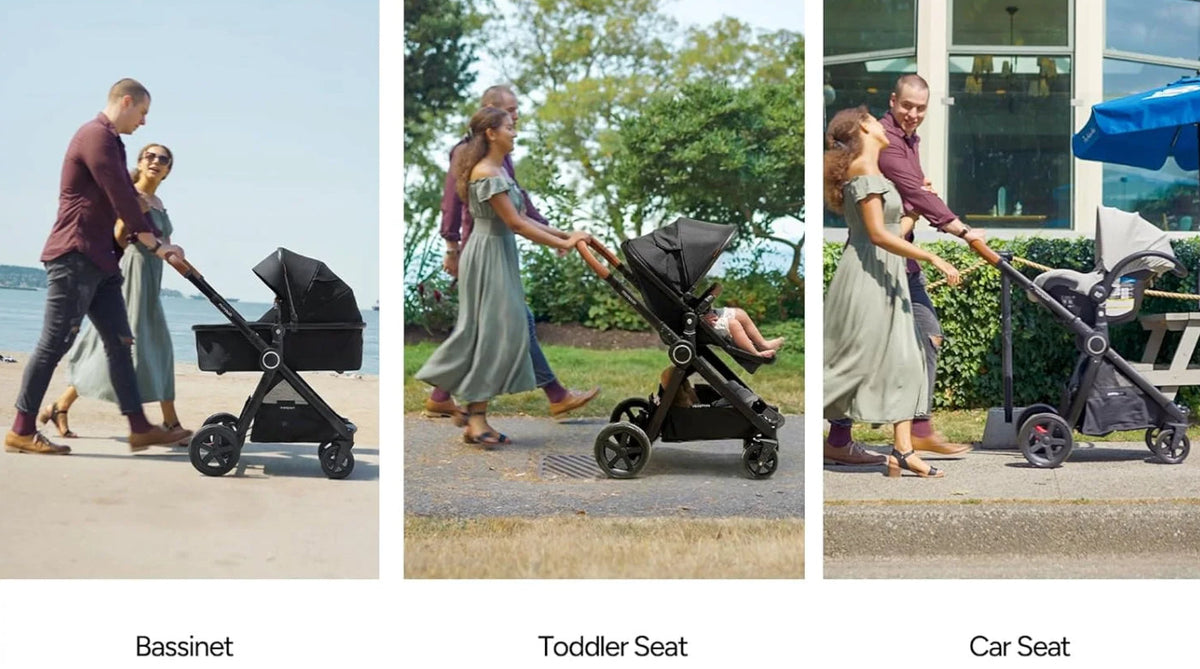
Quick answer: A travel stroller (roughly 13–16 pounds) is built for portability: tight folds, overhead-bin ambitions, one-hand carrying. A full-size stroller (20–30+ pounds) is built for comfort: big wheels, real suspension, a huge basket, and newborn-ready seats. Frequent flyers and apartment dwellers are usually happier with a travel stroller. Daily walkers, joggers-on-pavement, and parents starting with a newborn usually need a full-size. And there's a third option most comparison articles skip: a lightweight hybrid that covers about 90% of both jobs.
Here's a scenario you may already know. Last spring, a friend of mine we'll call Sarah landed at Denver International with her 14-month-old, a carry-on, and a car seat. Her full-size stroller, gate-checked as always, came up the jet bridge filthy, with a cracked wheel housing. Total time from plane door to curbside pickup: 40 minutes, mostly spent wrestling gear. Three months later she flew the same route with a 15-pound compact, folded it at the jet bridge, walked it down the aisle, and slid it into the overhead bin herself. Total elapsed time: eight minutes.
That contrast is the whole debate in miniature.
If you're expecting or shopping for a first stroller, you've probably hit this exact fork: travel stroller vs full size stroller. Buy the wrong one and you either fight a 28-pound tank every day or push a flimsy umbrella frame down cracked sidewalks. This guide breaks down the real differences (weight, fold, price, newborn use, airline rules). It tells you honestly where each type wins, and shows why a growing number of families are skipping the "buy two strollers" trap entirely.
Key Takeaways
- Travel strollers weigh about 13–16 lb and fold compactly enough for overhead bins and small trunks; full-size strollers weigh 20–30+ lb and prioritize ride comfort, storage, and newborn support.
- Most travel strollers are rated for 6 months and up, so using one from birth requires a full-flat recline, a newborn insert, or a car seat adapter.
- U.S. airlines let you gate-check one stroller per child for free, but only a compact-fold travel stroller reliably fits a standard overhead bin.
- Expect to pay roughly $160–$300 for a quality travel stroller and $330–$500 for a quality full-size model.
- The smartest move for many families: one lightweight full-size-style hybrid instead of two strollers. Mompush's lightweight lineup (Velo, Nexis, Lithe V2, Nova, $160–$300) covers travel duty while the Ultimate line handles full-size comfort.
What's the Real Difference Between a Travel Stroller and a Full-Size Stroller?
Strip away the marketing and four factors separate the two categories: weight, fold, price, and features.
Weight. A true travel stroller lands between 13 and 16 pounds. Anything much lighter is an umbrella stroller with minimal padding; anything heavier starts flirting with full-size territory. Full-size strollers run 20 to over 30 pounds once you count the frame, seat, and wheels. Six pounds sounds trivial until you're carrying a stroller up a subway staircase with a baby on your hip.
Fold. Travel strollers fold into long, slim rectangles, often with a one-hand or shoulder-carry fold. That geometry is what gets them into overhead bins, trunk footwells, and apartment closets. Full-size strollers fold, too, but the result is a bulky package that typically eats most of a sedan trunk.
Price. Quality travel strollers cluster between $160 and $300. Quality full-size strollers generally run $330 to $500, and premium modular systems go higher. So the "buy both" plan can easily top $700 before accessories.
Features. This is where full-size models justify their bulk: bigger wheels, suspension, deep reclines, adjustable footrests, extra-large baskets, and expandable canopies. Travel strollers trade those comforts for a frame you can actually live with on the go. For a deeper look at how seat type shapes newborn use, see the newborn section below.
Travel Stroller vs. Full-Size Stroller: Side-by-Side Comparison
| Feature | Travel Stroller | Full-Size Stroller |
|---|---|---|
| Weight | 13–16 lb | 20–30+ lb |
| Folded size | Slim, compact; often fits overhead bins | Bulky; usually fills a sedan trunk |
| Newborn use | Limited; most rated 6 months+ unless full-flat recline, insert, or car seat compatible | Excellent; bassinet options, deep recline, infant inserts |
| Wheels & suspension | Small wheels, minimal suspension | Larger wheels, real suspension, better on rough ground |
| Storage basket | Small to medium | Extra large |
| Price range | $160–$300 | $330–$500+ |
| Air travel | Can often go in the cabin; gate-check if too big | Gate-check only; arrives dirty and sometimes damaged |
| Best for | Airports, transit, small cars, apartments, backup | Daily walks, rough terrain, naps on the go, newborn stage |
Where Travel Strollers Win
Airports. This is the travel stroller's home turf. A compact fold means you might carry it down the jet bridge instead of handing it to a ramp agent. If it doesn't fit the sizer, every major U.S. airline gates it for free at the aircraft door. Either way, you have wheels from check-in to boarding.
Public transit. Subway turnstiles, bus ramps, and elevator-less stations are all easier with a 14-pound fold. If your week involves more stairs than parking lots, this alone can decide the purchase.
Small cars. In a compact SUV or sedan, a full-size stroller plus a week of groceries is a Tetris game you lose. A compact model drops into the footwell behind the driver's seat. Ask Alex in Sacramento: after his second child arrived, his Honda Civic's trunk held the full-size stroller, and the diaper bag rode on his son's lap for six months. The lightweight option ended that particular family negotiation in one afternoon.
Apartments and city living. Narrow elevator doors, third-floor walk-ups, and hall closets that double as stroller garages all favor compact frames.
Grandparents' house. A travel stroller is the classic "car stroller" that lives in the trunk for occasional visits, errands, and restaurant dinners.
Modern compacts have gotten impressively light. Compare the folds side by side in our travel strollers collection.
Where Full-Size Strollers Win
Daily walks and rough terrain. Small hard plastic wheels transmit every sidewalk crack straight into the stroller. Full-size models with larger wheels and suspension absorb the bumps, which matters if you walk 45 minutes a day or live somewhere with unpaved paths.
Nap comfort. A deep recline, padded seat, adjustable leg rest, and big canopy turn a stroller into a mobile bedroom. Compact models recline, but usually not to the same angle, and the seats are noticeably firmer.
Storage. A full-size basket swallows a diaper bag, a grocery run, and a blanket. Travel stroller baskets fit a diaper bag. Maybe.
Newborn support. This is the big one, and the trap most first-time parents miss. Full-size strollers can take a bassinet or a fully flat reclining seat from day one. We cover the details in the newborn section below, because it's where the "travel stroller vs regular stroller" decision most often goes wrong.
Multi-stage value. Many full-size strollers convert to doubles or ride-on boards later. If you're planning for two kids under three, look at our double stroller options early so your first purchase doesn't strand you.
Can You Use a Travel Stroller Every Day?
Yes, and for a specific kind of family, it's the right answer. If you're a city household without a car, a compact stroller can absolutely be your only stroller. You walk everywhere, you fold it for the bus, you hang it by the door, and its small basket matters less because your grocery store is 200 feet away.
The honest caveats:
- Ride quality. On smooth pavement, fine. On brick, gravel, or broken sidewalks, your child feels every seam, and so do your wrists.
- Nap recline. If your toddler naps in the stroller daily at 1 p.m., check the maximum recline angle before committing. A seat that stops at 130 degrees produces short, cranky naps.
- Basket size. Consider adding stroller hooks for bags, because the basket will not do everything.
Nadia, a mom of one in a Chicago walk-up, is the textbook case. No car, fourth-floor apartment, transit commute. She sold her full-size stroller after four months of it blocking the hallway and never leaving the building. Her 15-pound compact has been the only stroller her daughter has known, from 8 months to age three. Daily use, zero regrets, one rule: they plan long park days around nap time at home.
The flip side: if you drive to trails, do long outdoor days, or have a newborn who lives in the stroller for contact naps on the move, a daily travel stroller will frustrate you. That's full-size territory.
Can a Travel Stroller Work for a Newborn?
Most travel strollers are rated for 6 months and up, and that rating exists for a safety reason: before babies can sit with support, they need either a fully flat surface or a car seat. Pushing a newborn in a semi-reclined stroller seat isn't just uncomfortable. It runs against the safe-positioning guidance from pediatric groups like the American Academy of Pediatrics, because young babies need a flat, firm surface.
So a travel stroller works from birth only if it offers one of these three:
- A true full-flat recline (close to 180 degrees, not "almost flat")
- A newborn insert or bassinet option that creates a flat, supported surface
- A car seat adapter so the infant seat clicks into the frame
If the model you're eyeing has none of the three, it's a 6-months-plus purchase. Plan accordingly: either start with a full-size stroller or a frame that takes your infant seat, or pick a compact model explicitly designed for newborns. Our guide to bassinet stroller vs. regular stroller walks through the flat-surface question in more depth.
Flying With a Stroller: Cabin, Gate-Check, and Size Rules
Here's the policy picture for U.S. carriers, and it's friendlier than most new parents expect:
- One stroller per child, free. Delta, United, American, Southwest, and other major U.S. airlines gate-check one stroller (plus one car seat) per child at no charge. It doesn't count as a checked bag.
- Gate-check means curbside delivery. Hand the stroller at the jet bridge, get it back either at the aircraft door or on the jet bridge after landing, depending on the plane. Bring a gate-check bag; hold bags are optional but they keep the grease off.
- Overhead bins have real dimensions. Most domestic carriers list roughly 22 x 14 x 9 inches for standard bins. A travel stroller with a slim, compact fold can genuinely fit; full-size strollers never will.
- Never check a stroller at the ticket counter if you can help it. Counter-checked strollers travel in the cargo hold, get handled like luggage, and come back exactly the way Sarah's did in Denver.
- TSA is a non-issue. Strollers pass through security with a quick fold and X-ray, or you can walk your child to the gate and gate-check there.
Practical tip: check your airline's specific carry-on dimensions before flying, because regional jets have smaller bins, and measure your stroller's folded footprint, not just its weight.
The $700 Question: One Stroller That Does Both
Which leaves the $700 question: two strollers, or one that does 90% of both jobs?
Here's the case for the single hybrid. A modern lightweight stroller in the 15-to-20-pound range gives you:
- a compact one-hand fold that handles most trunks and many overhead bins
- a comfortable multi-position recline for naps
- a newborn-flat seat on the right models
- decent wheels for city walking
- a basket that carries a real diaper bag
What it gives up against a heavyweight full-size is mainly monster-wheel suspension and extra-large storage. What it gives up against a true ultralight travel stroller is three or four pounds. For most families, three or four pounds is a trade worth making once instead of paying $700 twice.
That's exactly the gap Mompush's lightweight line is built to fill, and it's worth knowing the ladder:
- Mompush Nova ($179.99) and Lithe V2 ($179.99): the entry point. Sub-20-pound frames, quick folds, and easy carrying for errands, transit, and grandparent duty.
- Mompush Nexis ($199.99): the travel-workhorse pick. At about 19 pounds with a cabin-friendly compact fold and a true travel-stroller fold size, it handles airports and daily sidewalks without the umbrella-stroller wobble. Want to see the fold in action? Take a look at the Nexis lightweight travel stroller; it's the model most of our flying parents end up choosing.
- Mompush Velo ($299.99): the premium compact, with upgraded ride comfort and finish for families who want travel-stroller portability without travel-stroller compromises.
- Ultimate 2 ($329.99) and Ultimate 3 ($499.99): when you do want the full-size experience, the Ultimate line covers it, from bassinet-ready newborn setups to toddlerhood.
The pricing logic is the quiet advantage. A Velo or Nexis plus an Ultimate 2 still costs less than many single premium strollers. Each purchase also comes with a 100-day risk-free trial, free shipping and returns, and a 4-year extended warranty. If the fold disappoints you at gate B12, you send it back.
If your family is about to become a two-kid operation instead, the calculus shifts toward a double, and our guide to a double stroller for a newborn and toddler covers that transition in full.
FAQ: Travel Stroller vs. Full-Size Stroller
Are travel strollers worth it?
If you fly more than three times a year, commute on transit, drive a small car, or need a second stroller for the grandparents' trunk, yes, a travel stroller earns its keep fast. If you mostly walk your neighborhood with no car and no flights, one good full-size stroller serves you better than two compromise purchases. Match the stroller to your calendar, not to Instagram.
Can a travel stroller be used from birth?
Only if it has a full-flat recline, a newborn insert or bassinet, or a car seat adapter. Most travel strollers are rated 6 months and up because young infants need a flat, supportive surface. Check the minimum weight and recline specifications before buying if you plan to use it in the first months.
Can you take a travel stroller on a plane?
Yes. If the folded stroller fits your airline's carry-on dimensions (typically about 22 x 14 x 9 inches), it can go in the overhead bin. If it doesn't fit, gate-check it at the jet bridge for free; every major U.S. airline allows one stroller per child at no charge.
What is considered a full-size stroller?
A full-size stroller generally weighs 20 to 30+ pounds, has larger wheels with suspension, an extra-large storage basket, and a multi-position seat designed to grow from newborn to toddler. Think modular convertible systems and classic everyday strollers, as opposed to compact folds and umbrella frames.
Do travel strollers last as long?
Durability is usually fine: most travel strollers are rated to hold 40 to 50 pounds, so they carry a child through toddlerhood. The real limit is comfort, not lifespan. Smaller wheels, firmer seats, and smaller canopies matter more as your child grows and naps shift into the stroller.
Should I buy a travel stroller or a full-size stroller first?
If your baby is under 6 months and you walk daily, buy the full-size first for newborn-safe recline and comfort, then add a compact stroller around month six. If you're frequent flyers or your baby will be 6 months or older when you start stroller life, buy the travel stroller first and skip the full-size unless daily walks demand it.
One Stroller or Two? Making the Call
The travel stroller vs full size stroller decision comes down to an honest audit of your week. Count your flights, your staircases, your trunk space, and your sidewalk miles. Frequent travelers, transit riders, and small-car families should start with a compact stroller. Daily walkers with newborns should start full-size. And if you refuse to choose, start with a lightweight hybrid: the Nexis or Velo covers airports and errands, and an Ultimate covers the newborn-to-toddler comfort mission.
Whatever you pick, remember Sarah's eight minutes. Buy from a brand that lets you change your mind. Every Mompush stroller ships free with a 100-day risk-free trial and a 4-year extended warranty, so the only real risk is pushing the wrong stroller for another year.