
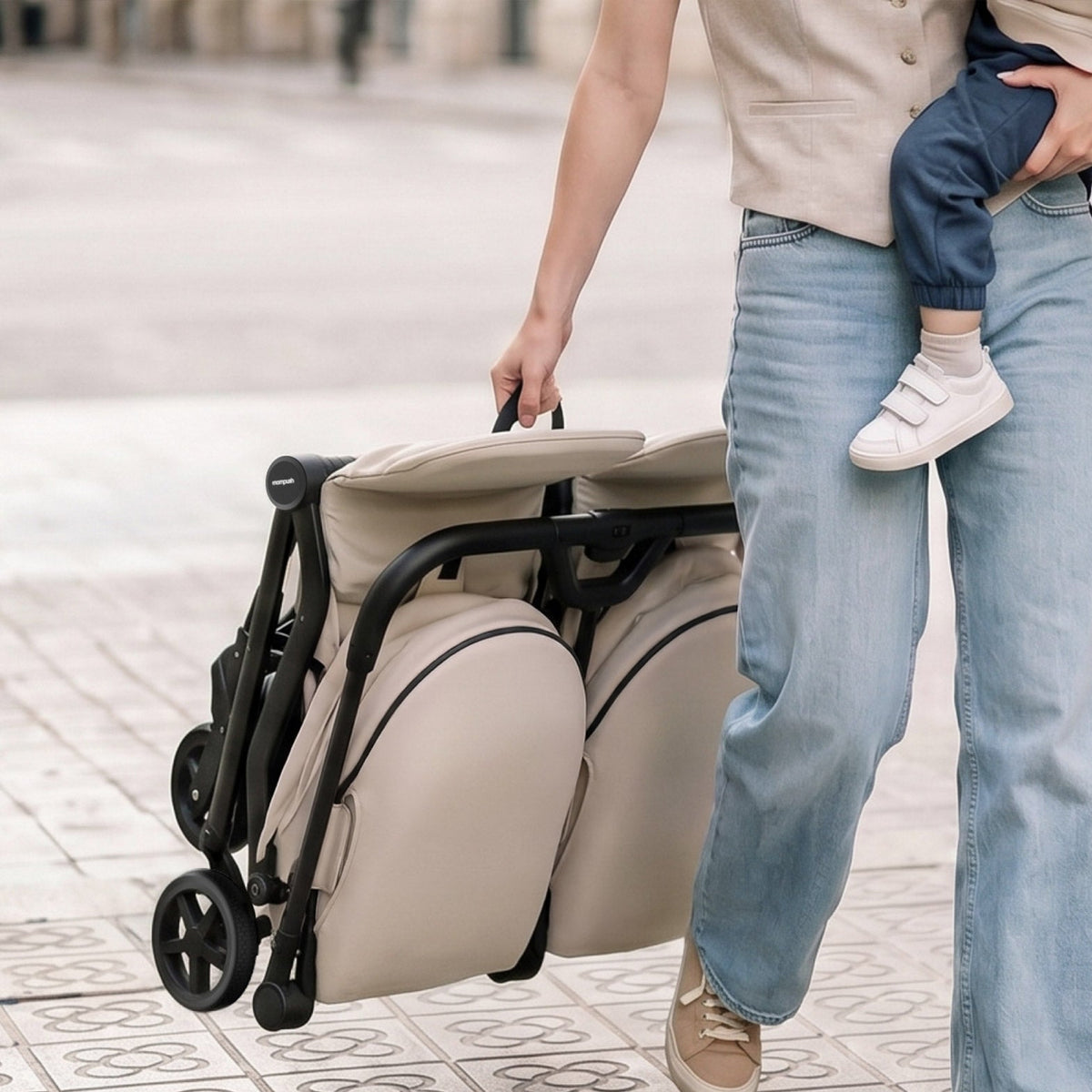
The best stroller for a newborn is one whose manufacturer explicitly approves it for use from birth in the configuration you plan to use — an approved bassinet, a newborn-rated flat-reclining seat, or an infant car seat on compatible adapters. Recline angle alone does not establish newborn suitability; check the model's rated age range, weight limits, and manual before you buy.
That answer covers most of what you need, but the details matter when you're spending several hundred dollars. In the next few minutes, you'll learn the three safe ways to stroll with a newborn, which one fits your actual life, how long each setup lasts, and which specific strollers are ready from day one.
Key Takeaways
- Newborns need a from-birth-approved configuration: a manufacturer-approved bassinet, a newborn-rated flat-reclining seat, or an infant car seat on a compatible frame — per the product's manual, not just its recline angle.
- Bassinet strollers and infant car seats serve different trips: car seats shine for drives, flat-riding setups shine for walks.
- Babies typically outgrow the bassinet within the manufacturer's stated age, weight, and developmental limits (commonly around 3–6 months) — the exact stop-use conditions live in your model's manual.
- A convertible stroller's newborn module spreads its cost across years of use, unlike a dedicated pram used only in the newborn months — an illustrative comparison, not a guarantee.
- From the Momplus line, the Ultimate 3 and Ultimate 2 offer detachable bassinets in their With-Bassinet configurations, and the Wiz family offers from-birth carriage-mode use — confirm the configuration you're buying includes the newborn module.
What Is a Bassinet Stroller?
A bassinet stroller carries your baby in a flat, enclosed basket with a firm mattress and raised sides. Your newborn lies horizontal, the way they would in a crib, just rolling along the sidewalk instead of sitting still.
Two designs exist. A dedicated pram has a permanent bassinet. A convertible stroller has a seat that unfolds into a flat bassinet position, or accepts a bassinet module on the same frame. The convertible approach has largely taken over, for a simple reason: your baby only needs the bassinet for a few months, and then you want the regular seat back.
One safety distinction worth knowing before you shop. Whether a stroller bassinet is approved for supervised naps — and for how long — is defined by the manufacturer's labeling and manual, not by the shape of the basket. Products certified for unsupervised and overnight rest are a separate category with their own testing standards. Check the specific product's labeling, and when you get home, move your baby to a crib or bassinet built for sleep, following CPSC safe-sleep guidance.
3 Ways to Stroll With a Newborn: Bassinet vs. Infant Car Seat vs. Lie-Flat Seat
| Bassinet Stroller | Infant Car Seat on a Frame | Lie-Flat Reclining Seat | |
|---|---|---|---|
| Riding position | Fully flat (180°) | Semi-reclined, car-seat angle | Fully flat to near-flat |
| From-birth use | Yes, per the bassinet's rated limits | Yes, when installed per the car seat manual (car or frame) | Only if the manufacturer rates the seat from birth |
| Walk suitability | Best for long walks | Fine for short trips, with regular breaks on longer drives | Good across trip lengths |
| Sleep use | Supervised naps, per manual | Not a sleep product — follow the manual | Supervised naps, per manual |
| Typical cost | Included or modular on convertibles | $150–$350 + frame | Included in many full-size strollers |
| Best for | Daily walkers, newborn months 0–6 | Families who drive everywhere | Budget-minded buyers wanting one setup |
All three are legitimate. What separates them is how you spend your days, which is the question the next section takes up.
Why Newborns Need a Flat-Lying Stroller
A newborn is not a small toddler. Until about 3 to 4 months, most babies are still developing head control, and the riding position they need is the one their product's manual calls for. What follows is how to verify that a stroller actually offers an approved newborn configuration — rather than just a deep-looking recline.
Rather than promising medical outcomes, use the manufacturer's documentation as your checklist. For each product you plan to use from birth, confirm:
- Rated use. The minimum age and weight the manufacturer states for the exact configuration — bassinet module, fully reclined seat, or car seat on adapters.
- Approved configuration. Whether that specific setup is approved for newborns. Recline angle alone does not establish suitability; a seat that lies flat is not automatically a bassinet, and neither is automatically a certified sleep product.
- Time-in-use guidance. Any limits the manual places on continuous or daily use. For car seats, follow the car seat manual, and plan regular breaks on longer trips.
Two authorities worth reading directly: the CPSC warns against letting babies sleep in inclined or sitting products (cpsc.gov), and pediatric guidance for car-seat travel centers on following the manufacturer's instructions (healthychildren.org). If your days involve a lot of non-driving strolling, a stroller with an approved newborn configuration keeps the car seat for the car.
Bassinet Stroller vs. Infant Car Seat: Which Is Better for Walks?
This is the comparison most buying guides skip, and it's the one that actually changes your day.
The car seat snapped onto a stroller frame is genuinely convenient for short trips. You transfer a sleeping baby from car to frame without waking them, run into the pharmacy, and roll back out. For those outings, it's the right tool.
The problem shows up on walks. First, the logistics: a car seat click-in unit is built for car-to-frame transfers, not for a 45-minute neighborhood loop with a growing baby inside. Second, and less discussed, the car seat is simply worse at being a stroller. It's heavy to push as a click-in unit, the baby stares at a canopy instead of the world, and sleep in a car-shaped shell isn't the same as rest on a proper mattress surface.
Illustrative example, not a quoted customer: a common pattern is a parent who buys a full travel system, then realizes the daily two-mile walks happen with the baby semi-reclined in the car seat — and adds a stroller with an approved bassinet configuration for the on-foot days. The lesson isn't that travel systems are wrong; it's that the car seat belongs to the driving portion of your week.
The practical rule: car seat for drives, an approved flat-riding configuration for everything on foot. If your week includes long walks, a stroller with a manufacturer-approved bassinet or newborn-rated seat earns its spot. Explore the Ultimate 2, which pairs a stroller seat with a separate detachable bassinet module (available in the With-Bassinet configuration) for exactly this reason.
How Long Can Each Newborn Setup Last?
Most babies use a stroller bassinet within the limits stated in the manufacturer's manual — commonly an age range through about 3 to 6 months and a weight cap in the 15-to-20-pound zone, but the exact stop-use conditions (age, weight, height, and developmental milestones) are set by each manufacturer and vary by model. When the bassinet's manual says your baby has outgrown it, the next step is the seat configuration your specific model supports — reaching a milestone in the bassinet does not automatically mean your baby meets the minimum requirements of another seat. An infant car seat follows its own manual for height, weight, and use.
We've covered the transition signals, seat-setup details, and what to do if rolling comes early in our full bassinet stroller vs regular stroller guide, so we'll keep the deep dive over there and stay on the buying questions here.
Are Bassinet Strollers Worth It? An Example Calculation
Honest math, because registries are full of items that don't survive contact with reality. This is an illustrative example — not a cost-per-use guarantee, since it depends entirely on how long and how often you actually use each option.
Assume a dedicated bassinet pram costs about $400 and covers the newborn months only. A convertible stroller with an approved bassinet configuration costs about $330 for the seat-only setup (roughly $400 with the bassinet module on some models) and then keeps serving as your everyday stroller for years. Over the same five flat months, the pram's entire cost is concentrated there, while the convertible's cost spreads across the years of use that follow. Whether the convertible comes out cheaper depends on the assumption you care most about: how much stroller life you get after month six.
None of this means a bassinet stroller is worth it for every family. If you drive everywhere and your walks are rare and short, your infant car seat plus a good stroller from 6 months is a defensible plan. The value case is strongest for one specific household: the daily walker. If you stroll the neighborhood every day, walk to coffee, or live somewhere errands happen on foot, the newborn months are your flat-riding season, and the convertible stroller is the setup that keeps earning after they end.
The Best Mompush Strollers for Newborns (Comparison)
| Stroller | Newborn configuration | Weight (per product page) | Price & configuration |
|---|---|---|---|
| Ultimate 3 | Detachable bassinet (With-Bassinet configuration); infant car seat adapter sold separately | 28.3 lb with seat · 29.4 lb with bassinet | $499.99 — check whether the selected package includes the bassinet |
| Ultimate 2 | Separate detachable bassinet module (With-Bassinet configuration) | 24.9 lb with seat · 27.5 lb with bassinet | $329.99 seat-only · $399.99 with bassinet — verify current configuration pricing |
| Wiz Pro | From-birth carriage-mode use per manual | See product page | $199.99 — verify current configuration |
| Wiz | 2-in-1 seat converts to carriage mode; infant car seat adapters required | 22.3 lb | $159.99 |
How to read it: the Ultimate 3 is the flagship for families who walk daily and want the smoothest ride, with the bassinet available in its With-Bassinet configuration. The Ultimate 2 pairs the same detachable-bassinet logic with a lower seat-only starting price — compare the complete newborn setup (frame + bassinet) rather than the seat-only price. The Wiz and Wiz Pro cover from-birth use at lower price points through their carriage-mode configurations. Note: confirm each model's current lineup role and price on its product page — Mompush's collection pages have recently listed newer models (e.g., Vira) alongside archive designations, and prices vary by configuration.
Compare the full range on the Mompush newborn strollers collection page, and see how the from-birth options compare with travel models in our guide to travel stroller vs full-size stroller.
Every stroller above ships free and is covered by Mompush's current trial, warranty, and certification programs — check the live policy and product pages for the terms, conditions, and certifications that apply to your specific model, configuration, and region.
FAQs
What is the best stroller for a newborn?
The best stroller for a newborn is a model whose manufacturer approves it for use from birth in the configuration you plan to use: an approved bassinet, a newborn-rated flat-reclining seat, or an infant car seat on compatible adapters. For families who walk regularly, a convertible stroller with an approved bassinet configuration is often the most versatile buy, because the same stroller transitions to the regular seat later and serves for years.
Do newborns need a bassinet stroller?
Newborns need a from-birth-approved riding configuration, and a bassinet stroller is one way to provide it. If your baby rides mostly in short car trips and brief outings, an infant car seat used per its manual can suffice. For daily walkers, a manufacturer-approved bassinet or newborn seat setup is the more comfortable configuration for the newborn months.
Which newborn setup fits a car-first family?
A travel system: the infant car seat for drives (used per its manual, with regular breaks on longer trips), clicked onto a frame stroller for the short in-between trips. When walks become part of your week, add a stroller with an approved bassinet configuration instead of a dedicated pram, since it keeps serving after the newborn months.
What should I check before buying a from-birth stroller?
Three things: the manufacturer's rated minimum age and weight for the exact configuration you plan to use, whether that configuration requires a separate module or adapter (and its cost), and the manual's stop-use conditions. Then check the fold and weight, because a from-birth stroller you can't lift daily won't get used.
Are bassinet strollers worth it?
For walking-focused families, often yes: the convertible's cost spreads across years of use, while a pram's cost concentrates in the three-to-six newborn months — an illustrative comparison, so pressure-test it against your own usage plans. For car-first households with rare walks, the value is thinner, and a car seat plus a stroller bought later is a reasonable alternative.
Which Mompush stroller is best for a newborn?
The Ultimate 2 pairs the line's lowest seat-only starting price ($329.99) with a separate detachable bassinet module — the With-Bassinet configuration runs about $399.99 at the time of writing (verify current configuration pricing on the product page). Families wanting the larger all-terrain build step up to the Ultimate 3 ($499.99, bassinet per selected configuration); budget-focused buyers can check the Wiz ($159.99, 2-in-1 carriage mode) and Wiz Pro ($199.99) from-birth setups.