
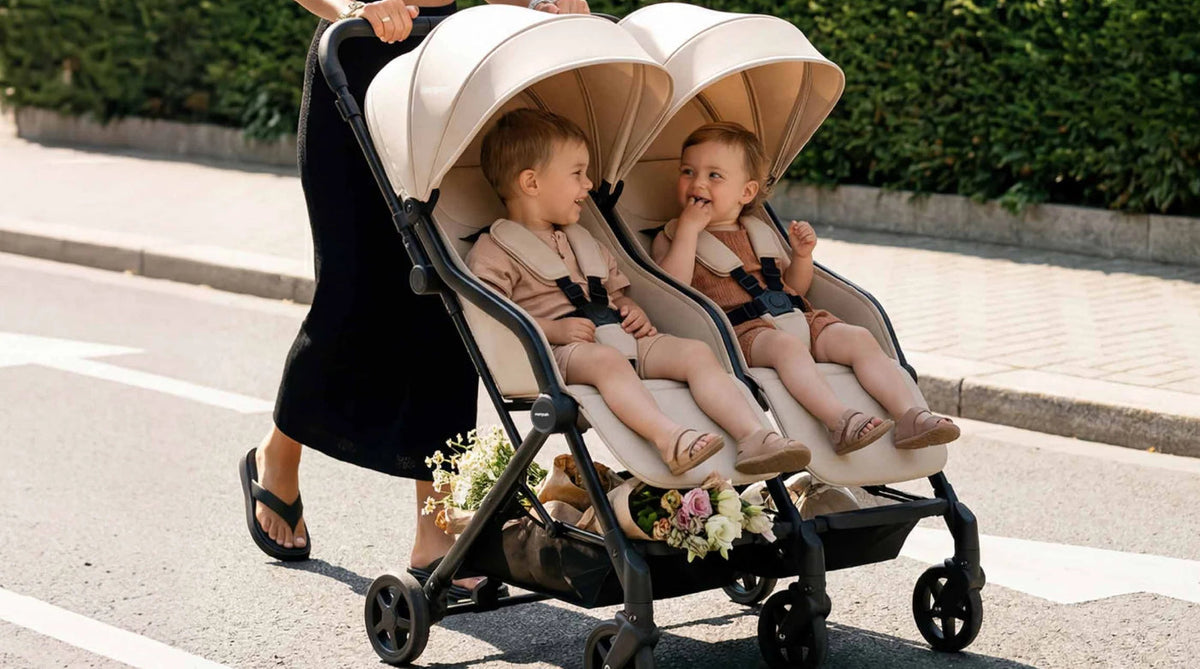
When Renee found out she was pregnant with her second, her daughter was nineteen months old. She remembers standing in the kitchen doing the math out loud: by the time the baby arrives, one kid still needs to be buckled into everything, and the other has just learned to sprint toward parking lots. The first thing she searched that night wasn't a minivan. It was a double stroller for newborn and toddler use, and she ended up more confused after an hour of reading than before she started.
If that's where you are right now, the rule that anchors everything else is this: a newborn can safely ride in a double stroller only in a lie-flat bassinet or a compatible infant car seat, never in an upright toddler seat. Everything else in this guide, from tandem versus side-by-side layouts to door widths and age-gap strategy, builds on that one rule.
Reading this before the baby arrives is a genuine advantage. You can pick a configuration that works from day one instead of replacing gear in six months. This guide walks you through the safety rules first, then the four types of double strollers, then the specific features and price points that matter in 2026. By the end, you'll know exactly which setup fits your kids' ages, your trunk, and your budget.
Key Takeaways
- A newborn can only ride in a double stroller in a lie-flat bassinet or a car-seat-compatible frame; upright seats are for babies with head control, usually around 6 months.
- Tandem strollers fit standard 30-inch doorways and keep the newborn closest to you, while side-by-side models give both kids equal views but run 30 to 31 inches wide.
- Sit-and-stand strollers suit a newborn plus a toddler aged 2.5 or older; younger toddlers need a real seat with a harness.
- Weight matters more than most parents expect: bulky doubles can top 30 pounds, while lightweight models like the Mompush Lithe Double (25.4 lbs, $239.99) stay under 26 pounds without giving up per-seat capacity.
- If your kids are 3 or more years apart, a single stroller plus a ride-along board may beat buying a double entirely.
Can a Newborn Ride in a Double Stroller? (Safety First)
Yes, but only in one of two ways: a fully lie-flat bassinet attachment or a compatible infant car seat clicked into the stroller frame. A standard upright toddler seat, even one that reclines partway, is not designed to support a newborn's head, neck, and airway.
This rule comes straight from pediatric guidance. The American Academy of Pediatrics notes that babies should sleep on firm, flat surfaces, and that sitting devices like car seats and strollers are not for routine sleep, especially before 4 months of age. The reason is physical: a newborn's neck muscles can't keep the head upright, and in a semi-reclined seat the chin can curl toward the chest and restrict breathing. Until your baby has reliable head control, typically around 6 months, the seat needs to lie essentially flat or hold an infant car seat.
The statistics back up why the harness matters too. A study of CPSC emergency room data published in Academic Pediatrics found an average of roughly 17,000 stroller- and carrier-related injuries per year among children under 5. Sixty to 65 percent were caused by falls, and most injuries happened to babies under 1. Buckling the five-point harness every single ride, even for a "quick" errand, prevents most of these.
So when you shop, filter out anything that can't take a bassinet or infant seat. Not sure how a bassinet setup differs from a standard reclining seat? We break it down in our guide to the bassinet stroller vs. a regular stroller, including which configurations actually get a newborn flat.
Want to compare bassinet-ready frames, car-seat-compatible options, and dedicated doubles side by side? Browse the full Mompush stroller collection.
4 Types of Double Strollers Compared
"Double stroller" is really four different products wearing the same name. Here's the honest breakdown.
| Type | Layout | Newborn-safe? | Typical width | Typical weight | Best for |
|---|---|---|---|---|---|
| Tandem | One seat in front of the other | Yes, with bassinet or car seat adapter | 25–30 in | 26–35 lbs | Narrow doorways, baby + toddler |
| Side-by-side | Two seats next to each other | Yes, with flat-recline seats or bassinets (model-dependent) | 30–31 in | 22–32 lbs | Same-age or similar-age siblings |
| Sit-and-stand | Front seat + rear bench/standing platform | Front seat only (bassinet or car seat on some models) | 24–26 in | 25–30 lbs | Newborn + toddler 2.5+ years |
| Convertible | Single that converts to double | Yes, on most models (add second seat or bassinet) | Varies, 24–30 in | 25–36 lbs | Growing families who want one purchase |
A few practical notes on that table. Tandem models thread through standard doorways without angling, because the length adds but the width doesn't. Side-by-side designs demand that you check width against your front door; most American interior doors run 30 to 32 inches, so a stroller at 31 inches or less is the safe zone. Convertibles cost the most upfront but spread that cost across your whole stroller life, since you buy one chassis that morphs as your family does.
The biggest mistake is buying by category instead of by configuration. A tandem that can't take a bassinet is useless to a family with a newborn, no matter how well it reviews. Start with "which seat positions can safely hold my baby on day one," then move to layout.
Tandem vs. Side-by-Side: Which Works for a Baby and Toddler?
With a newborn and a toddler, the choice usually comes down to one question: what does your older child need?
A tandem double stroller puts the seats front-to-back. That gives you three advantages. First, it fits doors without the awkward tilt-and-shimmy. Second, most tandems let the newborn ride in the rear position closest to your hands, where you can check on them without stopping. Third, the toddler in front gets a place to sit that isn't "stuck next to a crying baby."
A side-by-side double stroller for infant and toddler use wins on fairness and visibility. Both kids see the world equally, nobody gets a view of someone's backrest, and steering is often smoother because the weight sits centered rather than nose-heavy. The trade-off is width, and it's a real one. Two toddler-sized seats with canopies rarely compress below 30 inches.
My neighbor Tom learned this the expensive way. He bought a full-featured side-by-side before his second kid arrived, and it's a beautiful machine, except for one thing: it's 33 inches wide. Every Costco trip ends with him folding it to get through the entrance, unloading both kids into the cart, then reassembling it at the food court. He jokes that the stroller came with an unpaid gym membership. A 30-inch or narrower model would have made the same trip a non-event.
The rule of thumb: if your daily routes include medical buildings, older apartment elevators, or narrow store aisles, lean tandem. If your world is sidewalks, parks, and wide suburban storefronts, side-by-side is usually more pleasant for both kids.
7 Things to Look for in a Newborn-Ready Double Stroller
Whatever layout you pick, this checklist filters the field fast.
- Full recline or bassinet option for the newborn seat. Look for a seat that goes near-flat (roughly 150 degrees or more) or an actual bassinet. If the spec sheet maxes out at "multi-position recline" without a flat position, keep shopping.
- Infant car seat compatibility. If you own a car seat already, an adapter can save you hundreds. Check the compatibility list before you buy, not after.
- Per-seat weight capacity. Aim for 40 to 50 pounds per seat so both seats last into the preschool years. Also check total capacity; some doubles quietly lose capacity when fully loaded.
- Folded size and one-hand fold. A double you can't lift into your trunk alone becomes a porch ornament. Measure your trunk opening before ordering.
- Width under 31 inches. This is the difference between gliding through a doorway and performing geometry in public. For tandems, anything at 30 inches or under is comfortable.
- Independent five-point harnesses and reclines. A sleeping newborn and an upright toddler have opposite needs at the same moment. Independent adjustments let both kids ride happy.
- Frame weight. The whole stroller will be 10 to 15 pounds heavier than your old single, so a lightweight chassis pays off daily, on stairs, curbs, and in and out of the car.
One more thing worth saying plainly: certifications matter. Look for JPMA certification, which confirms the product meets or exceeds ASTM safety standards, and check that the manufacturer publishes its safety testing. It's the difference between marketing language and verified engineering.
The Dirty Secret of the Double Stroller Market
Here's where most buying guides go quiet, because there's a dirty secret in the double stroller market: most doubles are built like furniture. Full-featured tandem and convertible models routinely weigh 28 to 35 pounds unloaded. Add a 20-pound toddler and a car seat with a 9-pound baby, and you're lifting over 60 pounds multiple times a day.
A lightweight double stroller flips that equation, and for a baby-and-toddler household it usually makes more sense than a feature-stuffed tank. You lose things you rarely use, like giant air-filled tires on suburban pavement, and you keep everything that matters: flat recline, real harnesses, per-seat capacity, and the ability to actually get out of the house.
The Mompush Lithe Double is the clearest example of this category done right. At 25.4 pounds fully assembled, it's roughly 5 to 10 pounds lighter than comparable doubles. It measures just 30 inches wide, which means standard doorways and elevators, plus a footprint that fits theme-park stroller size limits. Both seats recline independently with adjustable footrests, each holds up to 40 pounds, and the whole thing folds to 28.9 by 13 by 23.2 inches, slim enough for a small trunk. It steers one-handed even with both kids loaded, which is the test that actually matters at 5 p.m. with groceries in the basket.
What If You Already Own a Single Stroller?
Before you buy anything, check whether your current baby stroller can convert. Many popular singles accept a second seat, a bassinet, or a ride-along board, and a $90 adapter beats a $400 purchase every time it works.
Three paths, in order of cost:
- Second-seat conversion. Brands like UPPAbaby, Bugaboo, and Mockingbird sell conversion kits that turn a single into a tandem double. Check whether your newborn can ride in the converted configuration, since some second seats are toddler-only.
- Bassinet or car-seat attachment. If your single frame accepts a bassinet or infant seat, you may only need a second seat when the baby is around 6 months old. Buying time this way is completely legitimate.
- Ride-along board. For a toddler over 2.5, a glider board on your existing single might be the whole answer, at least for a year or two.
There's also the option of skipping the double altogether with two singles, which some parents of twins use, but for a newborn and a toddler that means one parent can't take both kids out alone. That constraint ends most careers-of-two-singles quickly. If you do end up weighing two single purchases, our travel stroller vs full-size stroller guide covers when each format earns its place.
If your single is due for retirement anyway, the Ultimate 2 makes a strong case as the family workhorse: it takes a bassinet for the newborn months, converts into a full-featured everyday ride, and leaves you room in the budget for a lightweight travel stroller later.
Age-Gap Cheat Sheet: 12–18 Months vs. 2–3 Years Apart
The right double stroller for newborn and toddler combinations changes dramatically with the age gap, and almost nobody tells you this.
Kids 12 to 18 months apart: Buy a real double, either tandem or side-by-side, with newborn capability. Your older child is barely a toddler and genuinely needs a seat with a harness for the next two years. A sit-and-stand or a board is asking a 16-month-old to stand on a platform, which they can't safely do. Prioritize independent reclines, because one kid will be napping while the other wants to sightsee.
Kids about 2 years apart: This is the crossover zone. If the older child still naps reliably, a full double pays off. If they've dropped naps and walk well, a tandem with a bench-style rear seat or a good ride-along board can stretch further and cost less.
Kids 2.5 to 3+ years apart: Resist the urge to buy a heavy double. A sit-and-stand stroller, where the baby rides up front in a bassinet or car seat and the preschooler alternates between sitting and standing in back, fits this gap almost perfectly. These cost less, weigh less, and keep the big kid feeling like a big kid.
Dana learned this the hard way. Her boys are three years apart, and she bought a premium side-by-side "to be prepared." Her 3-year-old rode in it exactly eleven times before declaring he was "a walker now." The stroller did four more years of duty as a very expensive single with a decorative second seat. Match the gear to the gap.
FAQ
Can a newborn use a double stroller?
Yes, in two configurations only: a lie-flat bassinet or a compatible infant car seat. Both support the head, neck, and back, which an upright seat cannot do. Most babies are ready for a reclined toddler seat around 6 months, once they have steady head control. Never use an upright seat as a nap spot for a newborn.
Is a tandem or side-by-side better for a baby and toddler?
Tandem strollers fit standard doorways at 30 inches or narrower and let you position the newborn closest to you, which suits baby-and-toddler pairs. Side-by-side models give both children equal views and centered handling but need 30 to 31 inches of width. Choose tandem for narrow spaces, side-by-side for parks and wide sidewalks.
What is a sit-and-stand stroller, and is it right for a newborn?
A sit-and-stand has a front seat for the baby and a rear platform where an older child can sit or stand. The newborn rides safely in the front seat, bassinet, or car seat; the standing platform suits kids about 2.5 years and older. It's ideal for a newborn plus a preschooler, not for two under two.
How wide is too wide for a double stroller?
Most U.S. interior and storefront doors measure 30 to 32 inches. Keep a tandem at 30 inches or under and a side-by-side at about 30 to 31 inches. Anything wider will fight you at entrances, elevators, and older buildings. Always measure your own front door and trunk opening before buying.
What weight limits should I look for?
Look for 40 to 50 pounds per seat so both seats serve through age 4, and check total capacity, since some doubles cap the combined load. If you're considering a sit-and-stand, verify the standing platform limit separately, usually 40 to 50 pounds. Higher limits extend usable life and resale value.
When should my toddler switch to a ride-along board?
Around age 2.5 to 3, once your child can stand steadily, step on and off without help, and hold the stroller handle through turns. Before that, they need a secured seat with a harness. Boards work best for short outings and as a backup, not for long naps on the go.
Final Word: Match the Gear to the Gap
If you remember nothing else, remember this: newborn safety comes down to lie-flat or car seat, layout follows your doorways, and the age gap between your kids should drive the category more than any feature list. The right double stroller for newborn and toddler combinations follows those three rules in order. A tandem under 31 inches fits real American life. Independent reclines keep a sleeping baby and an awake toddler both content. And a lightweight double, done well, means you'll actually use the thing.
The common assumption is that "double stroller" automatically means heavy, expensive, and hard to steer. That was true in 2020. It isn't anymore. Models like the Mompush Lithe Double deliver side-by-side comfort, a 25.4-pound frame, and 30-inch width at $239.99, with a risk-free trial that removes almost all of the guesswork from the decision.
Renee, the mom from the beginning of this guide, ended up with a lightweight double, and her report two years later is the review that matters: "I never once got stuck in a doorway, and I never once regretted the weight." That's the whole goal.