
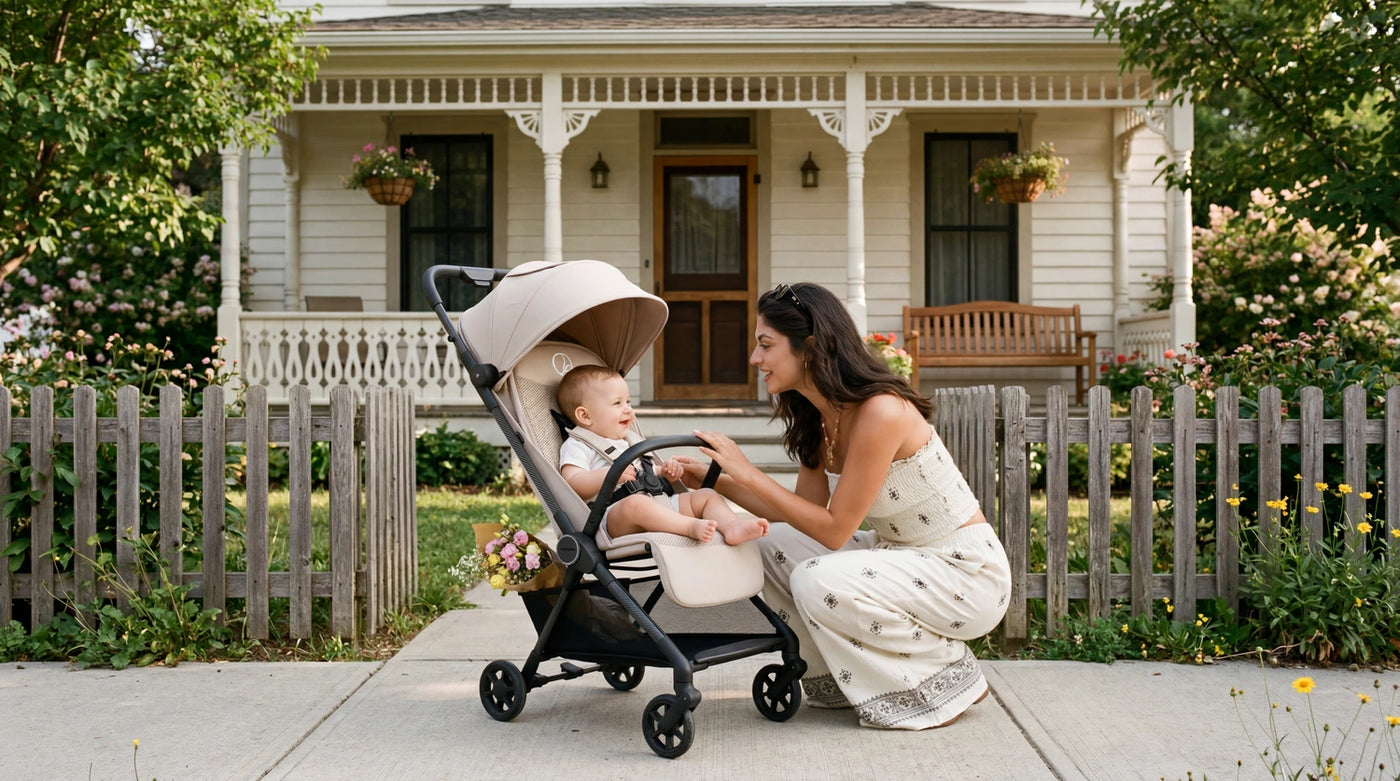
A travel system bundles an infant car seat, a compatible stroller, and a car seat base into one package, letting you move a sleeping baby from car to stroller without unbuckling. A standalone stroller is just the stroller: you buy it on its own and pair it with whatever car seat you choose. The right pick depends on your lifestyle, your budget, and how much you drive versus walk.
The travel system vs stroller debate trips up nearly every first-time parent. You're staring at a registry checklist, surrounded by terms that all sound the same. "Travel system," "stroller travel system," "modular stroller," "pram." Nobody has explained what actually differs between them. One box costs $200. The one next to it costs $600. Are you paying for features you'll use, or features you'll never touch?
You're not alone in the confusion. Market data shows that travel systems account for roughly 24% of all stroller sales globally, and demand in North America has surged as parents prioritize seamless car-to-stroller transitions. But that doesn't mean a travel system is automatically the right call for your family. A parent who walks everywhere in a dense city has very different needs from one who drives to every pediatrician appointment.
Consider Sarah and Tom, expectant parents from suburban Chicago. They spent three weekends at Buy Buy Baby, walking out each time more confused than the last. "Every salesperson told us something different," Sarah recalls. "One was like, 'you need a travel system.' The next one said we'd be wasting money on the stroller that came with it. We ended up buying a $450 travel system because we were exhausted and just wanted the decision made." Eight months later, their daughter outgrew the infant car seat. They realized the stroller in the bundle was heavier and less maneuverable than the one their friends had chosen separately. They ended up buying a second stroller anyway.
Keep reading. Five minutes from now, you'll know which option fits your life. We'll cover what a travel system includes, when a standalone stroller makes more sense, a side-by-side comparison, and a 5-question decision framework that cuts through the noise.
Key Takeaways
• A travel system includes an infant car seat, stroller frame, and car seat base sold together. Ideal for parents who drive frequently and want seamless car-to-stroller transitions.
• A standalone stroller gives you freedom to mix and match brands, often costs less upfront, and is lighter. But it requires separate car seat purchases and adapter research.
• Most babies outgrow infant car seats between 9 and 12 months (at 30–35 lbs or 30–32 inches), which means the car seat portion of a travel system has a limited lifespan.
• The AAP's "2-hour rule" limits car seat use to 2 hours at a time, making flat bassinets a safer option for extended outings with newborns.
• Convertible strollers that accept car seats and offer a bassinet mode give you the best of both worlds. One frame, multiple configurations, years of use.
What Is a Travel System?
The naming is confusing. Here's what each term means.
A travel system is a coordinated bundle that typically includes three components sold together:
Components: Infant Car Seat + Stroller Frame + Base
1. An infant car seat. A rear-facing carrier designed for newborns, usually rated for 22–35 pounds. It has a handle for carrying and clicks in and out of a base. The NHTSA provides detailed ratings for crash safety.
2. A car seat base. This stays permanently installed in your vehicle. The car seat clicks into it in seconds, so you're not re-threading a seat belt every trip. Most systems include one base; you can buy additional bases for a second vehicle.
3. A matching stroller. A full-size or compact stroller frame designed to accept the infant car seat directly. In the early months, you use the stroller as a car seat carrier. Once your baby outgrows the car seat (typically around 9–12 months), they transition to the stroller's built-in seat.
The core appeal is synergy. Everything works together right out of the box. No adapters to buy, no compatibility charts to decode. For a sleep-deprived new parent, that "don't make me think" simplicity matters.
Pros of Travel Systems
- Seamless car-to-stroller transitions. This is the #1 reason parents love them. Your baby falls asleep in the car. You arrive at Target. You unlatch the car seat, click it onto the stroller, and walk in, all without waking them. In the first 6 months, this feature alone can save your sanity.
- Guaranteed compatibility. No guesswork. The car seat and stroller are engineered to work together, and the manufacturer has tested the connection for safety.
- Lower upfront cost. Buying a bundle is almost always cheaper than purchasing each component separately. A mid-range travel system typically runs $300–$500, while buying a comparable stroller and car seat individually could cost $500–$700.
- One-stop shopping. One purchase, one warranty, one customer service contact. For parents already drowning in decisions, that simplicity is worth something.
For Andrea, a mom of three in suburban Atlanta, the click-and-go convenience was non-negotiable. "With my first baby, I was terrified of waking her during the transfer from car to stroller," she says. "The travel system meant I could unlatch the car seat, snap it onto the stroller, and be walking into the pediatrician's office in under 30 seconds, all while she stayed asleep. With my second and third, I was juggling diaper bags and a toddler's hand. That seamless transition wasn't a luxury. It was the only way I could leave the house alone."
Cons of Travel Systems
- The stroller can be an afterthought. In many bundles, the star of the show is the car seat. The included stroller may be heavier, bulkier, or less feature-rich than what you'd choose if you were shopping for a stroller on its own merits.
- Limited lifespan for the car seat. Most babies outgrow infant car seats between 9 and 12 months, when they hit 30–35 pounds or 30–32 inches in height. After that, you're left with just the stroller, which may or may not be the one you'd have picked independently.
- The 2-hour rule limits car seat stroller use. The AAP recommends that babies spend no more than 2 hours at a time in a car seat, whether in the car or on a stroller frame. The semi-reclined angle can cause positional asphyxia in young infants whose heads slump forward. For extended outings (a full day at the zoo, a long walk in the park), a flat bassinet is safer. For more on age-appropriate stroller use, see our guide on when baby can sit in a stroller.
- Bulk and weight. Travel system strollers tend to be larger to accommodate the car seat's weight and size. If you have a small car trunk, a narrow apartment hallway, or take public transit, that bulk becomes a daily frustration.
- Brand lock-in. You're restricted to the specific car seat and stroller pairing the manufacturer offers. If you fall in love with a different car seat's safety ratings, you can't swap it in without adapters, which may not exist.
Curious whether a convertible stroller could give you travel system convenience without the bulk?
Explore Mompush's Stroller Lineup →100-day risk-free trial · 4-year extended warranty
What Is a Standalone Stroller?
A standalone stroller is exactly what it sounds like: you buy the stroller by itself, no car seat included. This is the "à la carte" approach to baby gear. You choose the stroller based on its own merits (weight, fold mechanism, suspension, canopy size, storage capacity) and then separately purchase an infant car seat that fits your safety preferences.
This route gives you freedom. You might fall in love with a lightweight stroller from one brand and a top-rated car seat from another. With a standalone stroller and the right adapter, you can create your own custom stroller travel system. One that fits your exact priorities rather than a manufacturer's bundle strategy.
When a Separate Stroller Makes Sense
A standalone stroller shines in specific scenarios:
- You live in a walkable city. If your primary mode of transportation is your feet, a lightweight travel stroller that folds compactly and weighs under 20 pounds matters far more than car seat compatibility.
- You want "best in class" for each component. Maybe you've researched car seats exhaustively and want a specific model for its crash test ratings. A standalone stroller lets you pair it with whatever stroller you prefer.
- You're planning for multiple children. A convertible stroller that can expand to a double stroller configuration is a smarter long-term investment than a single-child travel system you'll outgrow.
- You travel frequently by air. An airplane stroller or foldable stroller that fits in an overhead bin is a game-changer for flying with a baby. Most travel system strollers are too bulky to qualify.
Kevin and Maya, who live in a third-floor walk-up in Brooklyn, made the standalone choice and never looked back. "We don't own a car. We take the subway everywhere," Maya explains. "A travel system stroller would have been a disaster. It's too heavy to carry up three flights of stairs with a baby in one arm. We bought a 16-pound compact stroller that folds with one hand and fits in the overhead bin on flights. For the first four months, we used a baby carrier and a snap-on car seat frame that weighed almost nothing. Total spend: about $280. No regrets."
Pros and Cons
Pros:
- Maximum choice and customization. Mix and match brands.
- Often lighter and more compact than bundled options.
- Better long-term value if you invest in a premium stroller that lasts years.
- Can be paired with a bassinet attachment for safe newborn strolling.
Cons:
- Requires extra research to ensure car seat and stroller compatibility.
- You'll likely need to purchase a separate adapter (typically $30–$60).
- Higher total cost if you buy premium components individually.
- No guaranteed click-and-go convenience in the early months unless you verify adapter compatibility before purchasing.
Travel System vs Stroller: Side-by-Side Comparison
Here's how they compare across the factors that actually matter:
| Feature | Travel System | Standalone Stroller + Car Seat |
|---|---|---|
| Upfront Cost | $300–$500 (bundle savings) | $350–$700+ (separate purchases) |
| Convenience (0–6 mo) | Excellent. Click-and-go, no waking baby. | Good. Requires adapter, extra step. |
| Car Seat Compatibility | Guaranteed, out of the box. | Requires research + adapter purchase. |
| Long-Term Value | Moderate. Car seat outgrown by ~12 months. | High. Invest in a stroller that lasts years. |
| Weight & Bulk | Heavier and bulkier. | Wide range. Can choose ultra-lightweight. |
| Newborn Safety | Good for short trips. 2-hour car seat limit. | Excellent with bassinet attachment (flat surface). |
| Customization | Limited to manufacturer's pairing. | Virtually unlimited mix-and-match. |
| Best For | Suburban, car-centric families. | Urban, walking-focused, or travel-heavy families. |
| Storage Needs | Larger trunk and home storage required. | Can choose compact fold for small spaces. |
Travel systems win on convenience and price. Standalone strollers win on flexibility and weight. Neither is better. It depends on how you live.
How to Decide: 5 Questions to Ask Yourself
Forget brand names and marketing claims for a moment. Grab a notepad and answer these five questions honestly. Your answers will point you directly to the right choice.
1. What does my daily routine actually look like?
Be specific. Are you driving an SUV to Target, the pediatrician, and your parents' house? Or are you navigating subway stairs, hopping on buses, and walking to the grocery store? A car-centric, suburban lifestyle heavily favors the convenience of a travel system. An urban, on-foot lifestyle demands the lightweight, nimble nature of a standalone stroller.
2. What's my true budget, upfront and long-term?
If money is tight right now, a travel system gets you everything you need in one purchase and often costs less than buying components separately. If you have more to invest and care about long-term quality, a premium standalone stroller that lasts through multiple children is the smarter financial move. Don't forget to factor in the cost of a convertible car seat, which you'll need regardless of which path you choose, since babies outgrow infant car seats around their first birthday.
3. How much storage space do I have?
This is non-negotiable. Measure your car trunk. Measure your entryway or hallway closet. Compare those numbers to the stroller's folded dimensions listed on the manufacturer's website. A bulky stroller you have to wrestle with every day is a stroller you'll grow to resent, no matter how many features it has.
4. Do I plan on having more children soon?
If you're thinking about a second baby within 2–3 years, invest in a stroller that can convert to a double. Most travel system strollers are single-child only, meaning you'd need to buy an entirely new setup for baby number two. A convertible stroller that accepts a second seat or a tandem stroller configuration grows with your family.
5. How important is "best in class" to me?
Some parents want the top-rated car seat for crash safety and the top-rated stroller for maneuverability, even if they come from different brands. If that's you, the standalone route is the only way to get exactly what you want. If you're comfortable with a solid, reliable all-in-one solution, a travel system delivers everything you need without the research rabbit hole.
Still deciding?
Start a 100-Day Risk-Free Trial →Test the stroller on your actual daily routes. If it's not the right fit, returns are free.
Best Convertible Strollers That Work as Both
Here's the thing: you don't have to choose between a travel system and a standalone stroller. A well-designed convertible stroller gives you the best of both worlds. Car seat compatibility and a bassinet mode and a toddler seat, all on one frame.
The global stroller market reflects this trend. Modular systems that allow switching between car seat, bassinet, and upright configurations now account for over 30% of new product launches, as parents increasingly demand gear that adapts rather than gets replaced.
Mompush Ultimate 2 — The All-Rounder
The Mompush Ultimate 2 ($329.99) is a convertible stroller that starts as a bassinet stroller for your newborn, then transitions to a reversible seat for your toddler. It's compatible with major infant car seat brands via adapter, so you get the click-and-go convenience of a travel system without being locked into one car seat brand.
Why it works as both:
- Bassinet mode for safe, flat newborn napping (no 2-hour car seat limit)
- Car seat adapter compatibility for seamless car-to-stroller transitions
- Reversible toddler seat. Face mom or face the world.
- One-hand fold that fits in standard trunks
- Baby Safety Alliance certified, meeting ASTM F833 standards
Mompush Wiz Pro — The Budget-Smart Pick
The Mompush Wiz Pro ($199.99) offers car seat compatibility and a multi-position recline at nearly half the price of a typical travel system. It's ideal for parents who want travel system functionality without the travel system price tag. The recline goes deep enough for younger babies (with proper head support) and transitions to upright as they grow.
Mompush Lithe Double — For Growing Families
If you're expecting your second, the Mompush Lithe Double ($239.99) is an affordable double stroller that works as a lightweight double stroller without the premium price tag. One seat reclines for the baby while the other stays upright for the toddler. No need to buy a second stroller when baby number two arrives.
Every Mompush stroller comes with free shipping and returns, a 100-day risk-free trial, and a 4-year extended warranty. Investing in baby gear shouldn't feel like a gamble. Mompush has been featured by Babylist, The Bump, Parents, and TODAY for delivering premium features at accessible prices.
FAQ
What is a travel system vs a stroller?
A travel system is a bundle that includes an infant car seat, a stroller frame, and a car seat base, all designed to work together. A standalone stroller is just the stroller, purchased on its own, which you then pair with a separate car seat (often requiring an adapter). Travel systems prioritize convenience and guaranteed compatibility. Standalone strollers prioritize choice and customization.
Is a travel system worth it?
A travel system is worth it if you drive frequently, want seamless car-to-stroller transitions in the first 6–12 months, and prefer the simplicity of a single bundled purchase. It's typically cheaper upfront than buying components separately. However, if you walk more than you drive, prioritize lightweight design, or want to mix and match brands, a standalone stroller with a separate car seat may be the better investment.
Can you use a stroller without a travel system?
Absolutely. You can buy a standalone stroller and pair it with any infant car seat using a brand-specific adapter. Many premium strollers are designed to work with multiple car seat brands. You'll need to verify compatibility before purchasing, but this approach gives you maximum flexibility to choose the best stroller and the best car seat independently.
When do babies outgrow the infant car seat in a travel system?
Most babies outgrow infant car seats between 9 and 12 months, when they reach the maximum weight limit (typically 30–35 pounds) or height limit (usually 30–32 inches). The clearest sign is when less than one inch of hard shell remains above the top of your baby's head. At that point, you transition to a convertible car seat (still rear-facing) and use the stroller's built-in toddler seat.
Can a travel system stroller be used from birth?
Most travel system strollers can be used from birth by clicking the infant car seat onto the frame. However, the AAP recommends limiting car seat time to 2 hours and advises against using car seats for routine sleep. For longer outings with a newborn, a stroller with a bassinet attachment (which provides a fully flat, safe sleep surface) is preferable. Some travel systems include a bassinet; others offer it as a separate purchase.
What's the difference between a travel system and a modular stroller?
A travel system typically refers to a car seat + stroller bundle with a fixed configuration. A modular stroller is a single frame that accepts multiple attachments: bassinet, infant car seat, and toddler seat, often with reversible seat directions. Modular strollers are more flexible and tend to last longer, but they're usually more expensive. Many modern strollers, including the Mompush Ultimate 2, blur the line by offering both car seat compatibility and bassinet mode on a convertible frame.
Conclusion
The travel system vs stroller decision comes down to one fundamental question: how do you move through the world with your baby?
If you're a driver who values click-and-go convenience and wants everything in one box, a travel system delivers exactly that. If you're a walker who prioritizes weight, compactness, and the freedom to choose your own car seat, a standalone stroller is your match.
The bottom line:
- Travel systems bundle a car seat, base, and stroller. Best for car-centric families and budget-conscious first-time buyers.
- Standalone strollers offer maximum choice and lighter weight. Best for urban families, frequent travelers, and parents who want best-in-class for each component.
- Most babies outgrow infant car seats by 12 months, so plan for the long game.
- The AAP's 2-hour rule means car seat stroller use has built-in limits. A bassinet attachment is safer for extended outings.
- Convertible strollers like the Mompush Ultimate 2 give you both travel system convenience and standalone flexibility. Bassinet, car seat adapter, and toddler seat on one frame.
Don't let the terminology overwhelm you. The best stroller is the one that fits your daily life. Your car, your apartment, your sidewalks, your family plan. Mompush strollers are designed to adapt as your needs change, with a 100-day risk-free trial so you can be sure.
The right stroller fits your life. Not the other way around.
When Can Baby Sit in Stroller? Age & Safety Guide